I was recently asked to speak at Career Day at a high school in Brooklyn. There were many people speaking about their careers in journalism, art, business, science careers and more. Here's what I told the students (in no particular order) attending the section I talked at: Education.
1. Spend your twenties in school (especially if you don't yet have the responsibilities of marriage, children, etc.)
2. Like what you do--be passionate about it.
3. Be creative and flexible in your life. If you don't like your job, think about how you can find a new one.
4. Take a risk--especially if you are young and don't have lots of debt. That means--travel, start a business, try many different jobs.
5. You can do more than one thing with your life. You can be a teacher and an artist.
6. Think about what your skills are--can you write? Are you a great researcher? Are you great with technology? Are you a people person?
7. The jobs that will be available to you when you graduate are not even invented now. How can you stay current?
8. Obtain 21st century skills in whatever you do--creativity, collaboration, critical thinking.
9. Be a go-getter. This may include writing letters or tweeting people you admire or you may want to meet.
10. Intern and volunteer NOW.

EDUBETH---IDEAS ON EDUCATION
Sunday, March 27, 2011
Thursday, March 24, 2011
Tux Typing for Kids
I'm spending the night exploring new open source programs and on SourceForge.net I typed in education and just found this amazing typing program for kids called Tux Typing. I downloaded it--as my computer warned me that this software could be harmful to my computer--but with tons of recommendations, I decided to go for it. I'm always looking for interesting typing programs, because my younger child is still learning to type and it has proven to be a difficult task. He hunts and pecks at the keys, even though he is on his computer at least 3 to 4 hours a day. He has a program he does everynight from his school called Typing Aces which--yes, is boring! I can hardly wait to show him Tux Typeing! It's a penguin named Linux who sits at the bottom of the screen and there are various games that you play using the penguin. For example, you can do finger exercises as fish come down from the top of the screen or you can laser away fish--again, using correct typing finger placement. Brilliant! After spending quite a few dollars over the past few years on fun typing programs, I'm so happy that, finally, some developers have created one for free. Thank you open source developers. I noticed it had over 2100 downloads this week with 54 recommendations and the last time it was updated was June 8, 2010. Linux the Penguin, you may just become my new BFF.
Yes, Open Source is Great for Educators
Open Source is free software that anyone can download for free. But, it's more--it involves giving away code and a community that works, edits, preserves and constantly improves on the project. Wikipedia notes that open source software has to have the following requirements:
the freedom to run the program, for any purpose; the freedom to study how the program works; and modify it (access to the source code is a precondition for this); the freedom to redistribute copies; the freedom to improve the program, and release the improvements to the public. One of my favorite sites to find open source software is:
http://opensourcemac.org which lists the best stuff for Mac. I've never used Juice before, but I'm eager to try it for podcasting. Of course, Firefox is amazing as is Cyberduck for FTPing files. I haven't looked at this site for about six months, but I can see that they've added a whole section on Education which features Moodle among others. If you don't want to purchase expensive software for a classroom or district, the best way to go is open source. I like the above site the best because it has simple downloadable instructions, clear graphics and easy-to-understand categories of what the software is and does. For students, I could see downloading any of the word processing programs as well as Audacity-a sound recording tool or Freemind which looks like Evernote for taking notes. There are also editing clients, wifi finders, protecting your laptop with an alarm and much more. While this page shows you open source projects that are stable, it is clear that the website is updated frequently by open source developers to showcase their wares. To quote the opensourcemac.org page, "Note to software creators: first of all, thanks so much for making free, open-source software-- we love you."
the freedom to run the program, for any purpose; the freedom to study how the program works; and modify it (access to the source code is a precondition for this); the freedom to redistribute copies; the freedom to improve the program, and release the improvements to the public. One of my favorite sites to find open source software is:
http://opensourcemac.org which lists the best stuff for Mac. I've never used Juice before, but I'm eager to try it for podcasting. Of course, Firefox is amazing as is Cyberduck for FTPing files. I haven't looked at this site for about six months, but I can see that they've added a whole section on Education which features Moodle among others. If you don't want to purchase expensive software for a classroom or district, the best way to go is open source. I like the above site the best because it has simple downloadable instructions, clear graphics and easy-to-understand categories of what the software is and does. For students, I could see downloading any of the word processing programs as well as Audacity-a sound recording tool or Freemind which looks like Evernote for taking notes. There are also editing clients, wifi finders, protecting your laptop with an alarm and much more. While this page shows you open source projects that are stable, it is clear that the website is updated frequently by open source developers to showcase their wares. To quote the opensourcemac.org page, "Note to software creators: first of all, thanks so much for making free, open-source software-- we love you."
Saturday, March 19, 2011
In an increasingly net enabled world...
Should our web tools be tightly connected or loosely aligned, and how do these decisions impact the classroom? This is an interesting question because I believe that web tools should be tightly aligned to state standards and content but, loosely aligned for students to explore. Take a look at this from Mohamed Amine Chatti's fascinating blog
http://mohamedaminiechatti.blogspot.com where he posted Michael Wesch's 2007 video Rethinking Education here: http://www.youtube.com/watch?v=5Xb5spS8pmE. Wesch talks about how the public is engaged in a level of writing, blogging and interactivity in unprecedented ways. Scanning, searching, editing, links, input, output are just some of the ideas that this video speaks about. Students want to be active, they want to create, categorize and not just consume. Yes, let's rethink the university! Let's rethink how kids learn and how they want to learn. How do we catch up with new processes? The public is living in a much larger sphere of information and knowledge. People want to make, create, share and explore collectively and together. Web tools like Tumblr, Google Sites, Blogger, Twitter, Facebook, Flickr, Delicious and more allow users to contribute to society with their opinions, ideas, pictures, thoughts, statements in an astounding way.
My question is--are teachers, administrators, principals really thinking about how to revise and redo course curriculum? It takes work and its totally different that teaching from the place where you are the giver of knowledge. Today, "we are harvesting collective intelligence" and we are on a new journey. People constructing knowledge--i.e. wikipedia--is good! Where are our students? What are our students doing? Let's Rethink Education!
http://mohamedaminiechatti.blogspot.com where he posted Michael Wesch's 2007 video Rethinking Education here: http://www.youtube.com/watch?v=5Xb5spS8pmE. Wesch talks about how the public is engaged in a level of writing, blogging and interactivity in unprecedented ways. Scanning, searching, editing, links, input, output are just some of the ideas that this video speaks about. Students want to be active, they want to create, categorize and not just consume. Yes, let's rethink the university! Let's rethink how kids learn and how they want to learn. How do we catch up with new processes? The public is living in a much larger sphere of information and knowledge. People want to make, create, share and explore collectively and together. Web tools like Tumblr, Google Sites, Blogger, Twitter, Facebook, Flickr, Delicious and more allow users to contribute to society with their opinions, ideas, pictures, thoughts, statements in an astounding way.
My question is--are teachers, administrators, principals really thinking about how to revise and redo course curriculum? It takes work and its totally different that teaching from the place where you are the giver of knowledge. Today, "we are harvesting collective intelligence" and we are on a new journey. People constructing knowledge--i.e. wikipedia--is good! Where are our students? What are our students doing? Let's Rethink Education!
Wednesday, March 2, 2011
Tech Kids Unlimited for Spec Needs Students --Animations Posted!
Here are the animations from Tech Kids Unlimited.
These were created with just seven hours of workshop time in Feb 2011.
http://vimeo.com/techcampunlimited
These were created with just seven hours of workshop time in Feb 2011.
http://vimeo.com/techcampunlimited
Monday, February 28, 2011
It's All About the Kids
On Webogg-ed, Will Richardson has excerpted out a part of his new book coming out in May 2011 called PERSONAL LEARNING NETWORKS: Using the Power of Connections to Transform Education at:
http://weblogg-ed.com/2011/personal-learning-networks-an-excerpt/. It looks like a great book!
In this excerpt he sites a teacher (Clarence Fisher) working in a very remote place who has connected himself and his students virtually via the internet and how it has significantly changed his classroom. He notes the power of a personal learning network to become "a connected learner." The students skype with other students around the world, watch Youtube and other videos and while doing so are involved in a virtual chat.
This teacher says his classroom is "thin-walled" to denote the ever-changing and shifting way that students gain knowledge. Fisher wrote on his own blog, the following:
"The connections have had very little to do with me. I’ve provided access, direction, and time, but little else. I have not had to make elaborate plans with teachers, nor have I had to coordinate efforts, parceling out contacts and juggling numbers. It is all about the kids. The kids have made contacts. They have begun to find voices that are meaningful to them, and voices they are interested in hearing more from. They are becoming connectors and mavens, drawing together strings of a community. They are beginning to expect to work in this way. They want to know what the people in their network are saying, to hear about their lives and their learning. They want feedback on their own learning, and they want to know they are surrounded by a community who hears them. They make no distinction about class, about race, about proficiency in English, or about geography. They are only interested in the conversation and what it means to them."
Richardson goes on to note the overwhelming amount of knowledge we have at our fingertips as compared to before the web. How, do we as educators, share the knowledge with our students? We can't spoonfeed them as was done in 19th and early 20th century paradigms of education. Instead, we must teach students to think about the journey of knowledge--where to find, access, define and use all of this accessible information. Richardson further notes that the old system of education--one size fits all, classrooms based on ages, traditional evaluations and assessments just don't work anymore. I agree. Richardson notes, "For each of us as learners in the world at large, the fundamental change is that we can be much more in control of the learning we do." The changing shift is that students and teachers can, should and need to be connected to one another in sharing knowledge. Personal Learning Networks like Delicious, Google Reader, Twitter and more make us one step closer to the knowledge each one of us has and each one of us is passionate about. So, as Facebook tells you: like it or share it. See you online!
http://weblogg-ed.com/2011/personal-learning-networks-an-excerpt/. It looks like a great book!
In this excerpt he sites a teacher (Clarence Fisher) working in a very remote place who has connected himself and his students virtually via the internet and how it has significantly changed his classroom. He notes the power of a personal learning network to become "a connected learner." The students skype with other students around the world, watch Youtube and other videos and while doing so are involved in a virtual chat.
This teacher says his classroom is "thin-walled" to denote the ever-changing and shifting way that students gain knowledge. Fisher wrote on his own blog, the following:
"The connections have had very little to do with me. I’ve provided access, direction, and time, but little else. I have not had to make elaborate plans with teachers, nor have I had to coordinate efforts, parceling out contacts and juggling numbers. It is all about the kids. The kids have made contacts. They have begun to find voices that are meaningful to them, and voices they are interested in hearing more from. They are becoming connectors and mavens, drawing together strings of a community. They are beginning to expect to work in this way. They want to know what the people in their network are saying, to hear about their lives and their learning. They want feedback on their own learning, and they want to know they are surrounded by a community who hears them. They make no distinction about class, about race, about proficiency in English, or about geography. They are only interested in the conversation and what it means to them."
Richardson goes on to note the overwhelming amount of knowledge we have at our fingertips as compared to before the web. How, do we as educators, share the knowledge with our students? We can't spoonfeed them as was done in 19th and early 20th century paradigms of education. Instead, we must teach students to think about the journey of knowledge--where to find, access, define and use all of this accessible information. Richardson further notes that the old system of education--one size fits all, classrooms based on ages, traditional evaluations and assessments just don't work anymore. I agree. Richardson notes, "For each of us as learners in the world at large, the fundamental change is that we can be much more in control of the learning we do." The changing shift is that students and teachers can, should and need to be connected to one another in sharing knowledge. Personal Learning Networks like Delicious, Google Reader, Twitter and more make us one step closer to the knowledge each one of us has and each one of us is passionate about. So, as Facebook tells you: like it or share it. See you online!
Sunday, February 27, 2011
Tech Kids Unlimited for Spec Needs Students
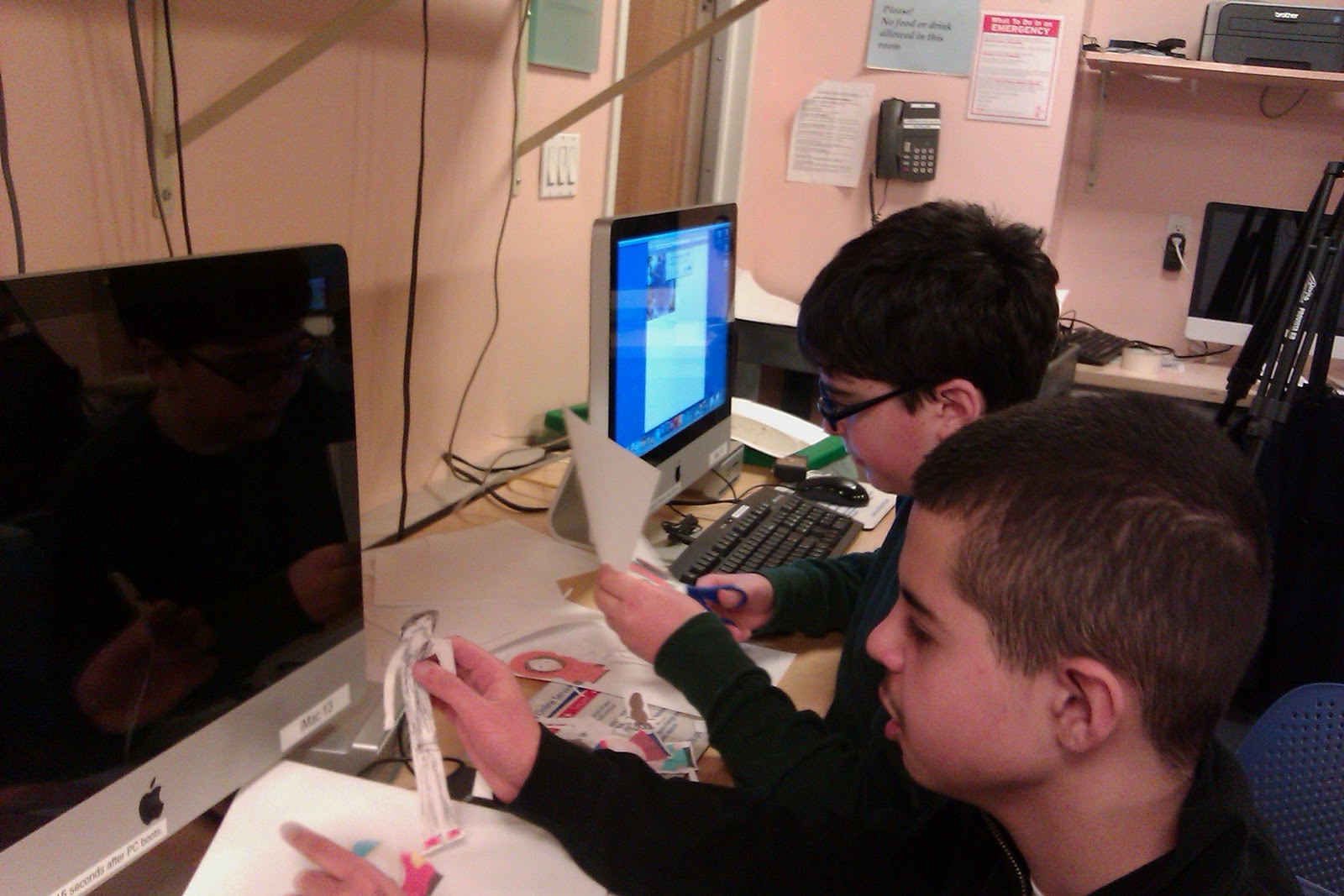


HE BENEFIITED FROM SO MANY IMPORTANT DYNAMICS SIMLTANEOUSLY: WORKING IN A GROUP, COOPERATING, BEING CREATIVE, ASKING FOR HELP APPROPRIATELY, TAKING TURNS, SHARING, FEELING PROUD OF HIS WORK/EFFORTS!
Subscribe to:
Posts (Atom)